In a recent study, scientists discovered that different hues of light at various times of the day behaviorally attract and repel mosquito species that bite at night as opposed to during the day.
The discoveries have significant implications for utilizing light to manage mosquitoes, one of the main disease vectors affecting both humans and animals worldwide.
The Aedes aegypti mosquito, sometimes known as the Yellow Fever mosquito, was investigated by a team lead by the University of California, Irvine School of Medicine (Anopheles coluzzi, a member of the Anopheles gambiae family, the major vector for malaria).
They discovered that the two species had different reactions to ultraviolet light and other light hues. Researchers also discovered that a mosquito's affinity for light is influenced by its species, sex, the time of day, and color.
"According to conventional opinion, insects are inherently drawn to ultraviolet light, which explains the pervasive use of UV light "bug zappers" for pest control.
We discover that while night-biting mosquitoes are strongly photophobic to short-wavelength light during the day, day-biting mosquitoes are drawn to a wide range of light spectra during the day "According to lead researcher Todd C. Holmes, PhD, a professor in the UCI School of Medicine's Department of Physiology and Biophysics.
Circadian Control of Light-Evoked Attraction and Avoidance Behaviors in Day vs Night Biting Mosquitoes is the title of a recent study that was just published in Current Biology. First author is Lisa S. Baik, a graduate research student at the UCI School of Medicine who just finished her Doctorate.
As carriers of illness, mosquitoes provide significant risks to both people and other animals. It is believed that half of all humans who have ever lived have perished as a result of illnesses carried by mosquitoes.
The new research demonstrates that day-biting mosquitoes are drawn to light during the day, regardless of spectrum, especially females that need blood meals to feed their fertilized eggs. In contrast, blue and ultraviolet (UV) light are especially avoided by mosquitoes that bite at night.
Prior research in the Holmes group identified the light sensors and circadian molecular pathways for light-mediated attraction/avoidance behaviors in fruit flies, which are related to mosquitoes.
Likewise, light-evoked attraction and avoidance behaviors in mosquitoes are significantly hampered by molecular disruption of the circadian clock. Currently, day vs night behavioral patterns that alter with daily cycles of light and dark are not taken into account by light-based insect controllers.
According to Holmes, "light is the principal regulator of circadian rhythms and inspires a wide range of time-of-day specific actions.
"We can create new, environmentally friendly options to managing hazardous insects more efficiently and lessen the demand for ecologically destructive toxic pesticides by better understanding how insects respond to short wavelength light in a species-specific manner."
The National Institutes of Health, National Science Foundation, and ARCS Foundation all contributed to the funding of this work. The prior investigations conducted by the Holmes group at the UCI School of Medicine and published in Science, Nature, and Proceedings of the National Academy of Sciences over the past few years serve as the foundation for this current study.

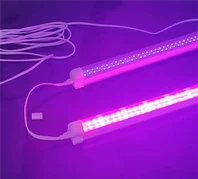
Benwei UV 120cm led tube black light Product Specification:
|
Item |
UV led light tube bulb T8 |
|
Input Volt |
AC85-265V |
|
Power |
10W,18W,24W |
|
Length |
60cm/2ft, 120cm/4ft, 150cm/5ft |
|
Bean Angle |
120°, 180° |
|
Lifespan |
50000 hrs |
|
Wavelength |
365nm 395nm 254nm 280nm |
|
Warranty |
3-5 years |